Charuvahan Adhivarahan
Multimodal Perception for Embodied Intelligence
Table of Contents

Charuvahan Adhivarahan
University at Buffalo, SUNY
Multimodal Perception & World Models for Autonomous Robots
Robots operating beyond controlled environments need representations that stay useful when sensor suites, physical surroundings, and embodiments change. My research builds multimodal representations and compact world models that integrate vision, depth, and non-visible spectra in real time, sustaining autonomy in unconstrained deployments.
Core Research Thrusts
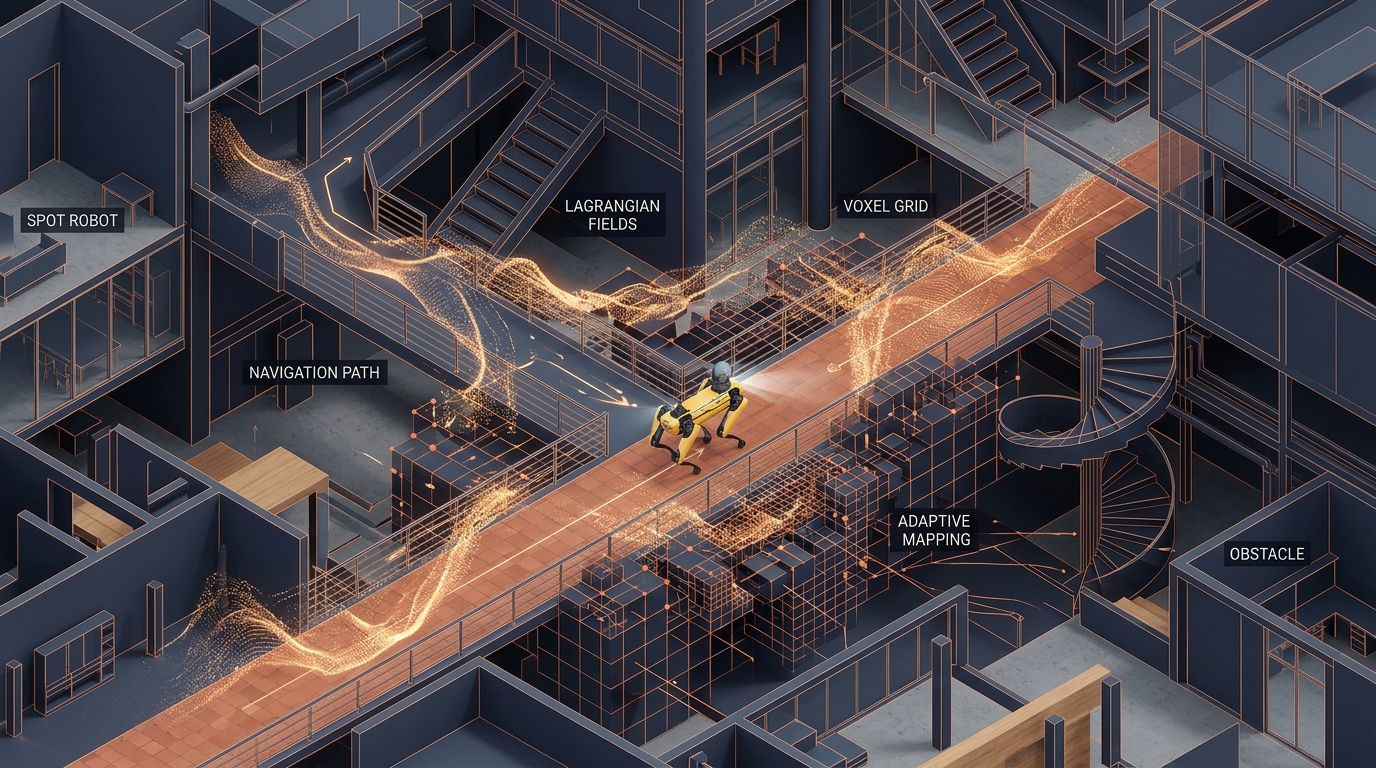
Adaptive Representations for Embodied Intelligence
Robots need to preserve the details that matter for action within limited compute, latency, and bandwidth budgets. I develop adaptive, multi-resolution spatial representations and Lagrangian neural fields that concentrate detail where the task requires it. GoLF (Graphs over Lagrangian Fields) grounds this work in structured representations for robot planning, with the goal of making perception responsive to both the environment and the robot’s resources.
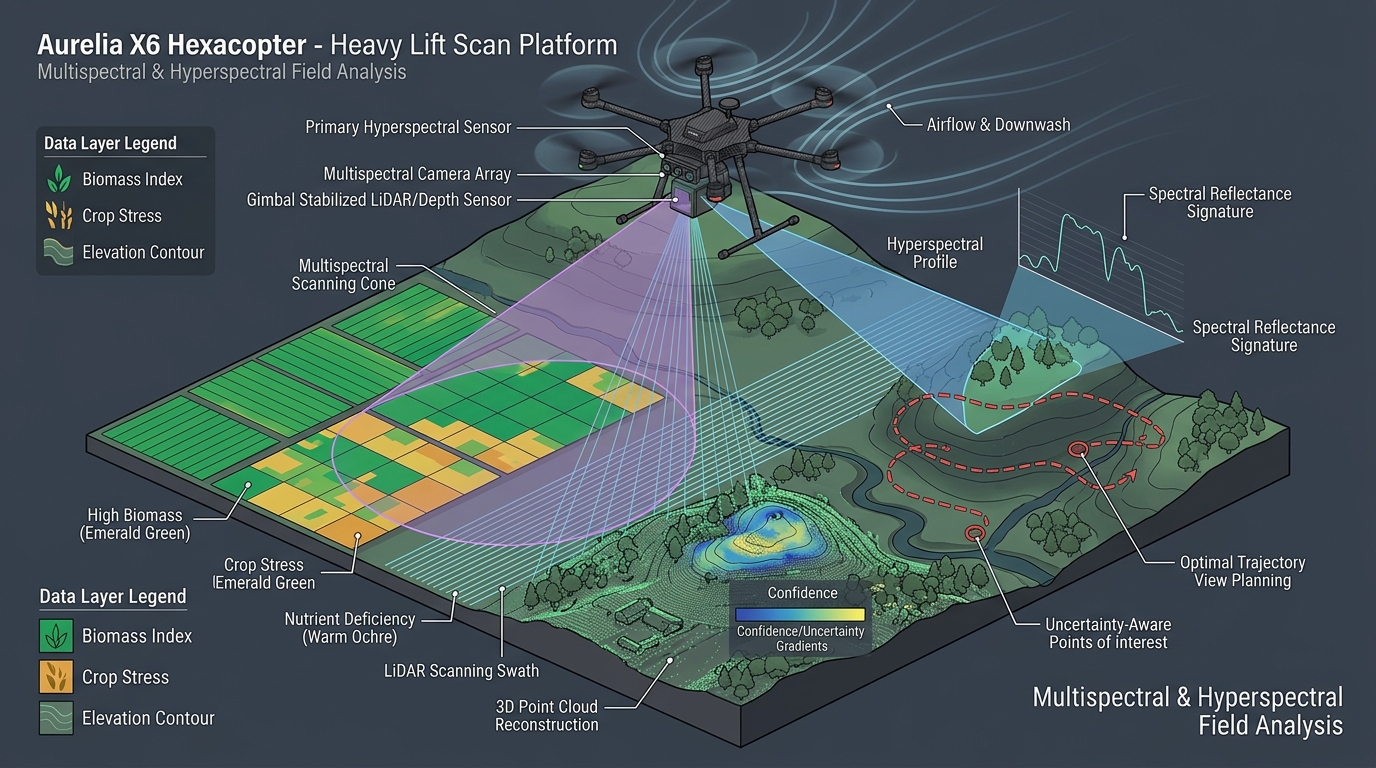
Adaptive & Active Mapping in Physical Worlds
A robot’s path determines what it can learn about its surroundings. I develop active perception methods that use uncertainty to choose informative viewpoints and trajectories for mapping physical phenomena. This work spans vegetation monitoring with VISTA and mapping invisible 3D airflow fields with Anemoi (ACM MobiCom ’23). The aim is to build accurate maps with fewer, carefully chosen observations.
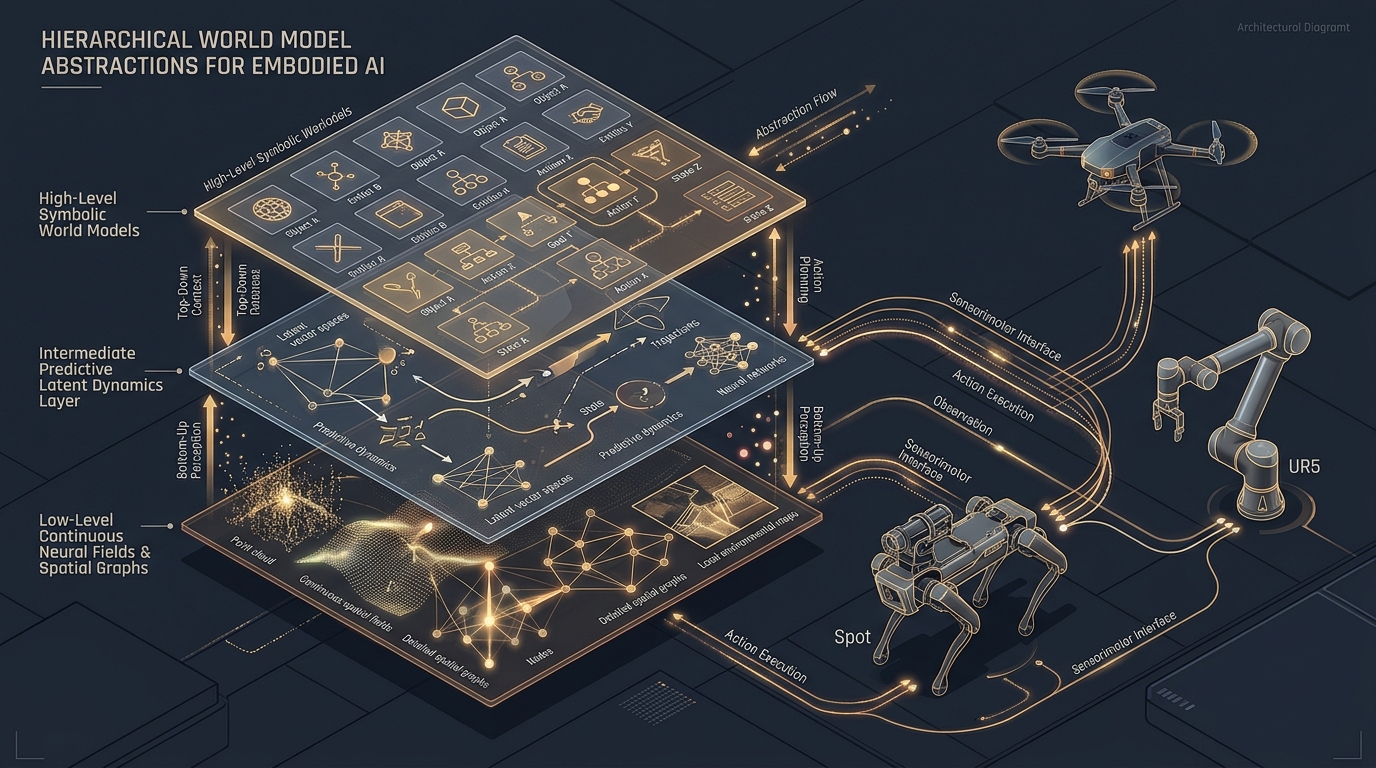
Hierarchical World Model Abstractions
How can a robot use what it has learned when its environment, sensors, or physical capabilities change? My future research will connect structured spatial representations such as GoLF with generative world models through hierarchical abstractions. I aim to link multimodal observations to higher-level reasoning, so robots can predict how their surroundings evolve, adapt from simulation to the physical world, and transfer knowledge across different robot embodiments.
Publications
CLEAR: A Semantic-Geometric Terrain Abstraction for Large-Scale Unstructured Environments
IEEE RA-L 2026@article{meshram2026clear,
title={CLEAR: A Semantic-Geometric Terrain Abstraction for Large-Scale Unstructured Environments},
author={Meshram, Pranay and Adhivarahan, Charuvahan and Esfahani, Ehsan Tarkesh and Chowdhury, Souma and Wang, Chen and Dantu, Karthik},
journal={IEEE Robotics and Automation Letters (RA-L)},
year={2026},
publisher={IEEE}
}
TIPS: Thermal Image based Plastics Sorting
ACM MobiSys 2026@inproceedings{duong2026tips,
title={TIPS: Thermal Image based Plastics Sorting},
author={Duong, Long and Adhivarahan, Charuvahan and Ayyalasomayajula, Roshan and Dantu, Karthik},
booktitle={Proceedings of the 24th ACM International Conference on Mobile Systems, Applications, and Services (MobiSys '26)},
year={2026},
doi={10.1145/3745756.3809202}
}
Determining the Percentage of Recycled Plastic Content in a Plastic Product
Nature Comm. Eng. 2026@article{zhao2026determining,
title={Determining the Percentage of Recycled Plastic Content in a Plastic Product},
author={Zhao, Yaoli and Adhivarahan, Charuvahan and Jyothula, Chandra Lekha and Dantu, Karthik and Thundat, Thomas and Goyal, Amit},
journal={Communications Engineering},
volume={5},
number={51},
year={2026},
doi={10.1038/s44172-026-00639-y},
publisher={Nature Publishing Group}
}
QAL: A Loss for Recall-Precision Balance in 3D Reconstruction
IEEE/CVF WACV 2026@inproceedings{meshram2026qal,
title={QAL: A Loss for Recall-Precision Balance in 3D Reconstruction},
author={Meshram, Pranay and Turkar, Yash and Singh, Kartikeya and Masilamani, Praveen Raj},
booktitle={IEEE/CVF Winter Conference on Applications of Computer Vision (WACV)},
year={2026}
}
Anemoi: A Low-cost Sensorless Indoor Drone System for Automatic Mapping of 3D Airflow Fields
ACM MobiCom 2023@inproceedings{xia2023anemoi,
title={Anemoi: A Low-cost Sensorless Indoor Drone System for Automatic Mapping of 3D Airflow Fields},
author={Xia, Stephen and Zhao, Minghui and Adhivarahan, Charuvahan and Hou, Kaiyuan and Chen, Yuyang and Nie, Jingping and Wu, Eugene and Dantu, Karthik and Jiang, Xiaofan},
booktitle={ACM MobiCom},
year={2023}
}
Adaptive Fovea for Scanning Depth Sensors
IJRR 2020@article{tasneem2020adaptive,
title={Adaptive Fovea for Scanning Depth Sensors},
author={Tasneem, Zaid and Adhivarahan, Charuvahan and Wang, Dingkang and Xie, Huikai and Dantu, Karthik and Koppal, Sanjeev J},
journal={The International Journal of Robotics Research},
volume={39},
number={7},
pages={837--855},
year={2020}
}
WISDOM: WIreless Sensing-assisted Distributed Online Mapping
IEEE ICRA 2019@inproceedings{adhivarahan2019wisdom,
title={WISDOM: WIreless Sensing-assisted Distributed Online Mapping},
author={Adhivarahan, Charuvahan and Dantu, Karthik},
booktitle={IEEE International Conference on Robotics and Automation (ICRA)},
pages={8026--8033},
year={2019}
}
Augmenting Visual SLAM with Wi-Fi Sensing for Indoor Applications
Autonomous Robots 2019@article{hashemifar2019augmenting,
title={Augmenting Visual SLAM with Wi-Fi Sensing for Indoor Applications},
author={Hashemifar, Zakieh S and Adhivarahan, Charuvahan and Balakrishnan, Anand and Dantu, Karthik},
journal={Autonomous Robots},
volume={43},
number={8},
pages={2245--2260},
year={2019}
}
Improving RGB-D SLAM using Wi-Fi
ACM/IEEE IPSN 2017@inproceedings{adhivarahan2017improving,
title={Improving RGB-D SLAM using Wi-Fi},
author={Adhivarahan, Charuvahan and Hashemifar, Zakieh Sadat and Dantu, Karthik},
booktitle={ACM/IEEE International Conference on Information Processing in Sensor Networks (IPSN)},
year={2017}
}
CLIPS: Continual Learning Infrastructure for Plastics Sorting
IEEE ICMLA 2025A View-Planning Approach to 3D Reconstruction
IEEE XR 2024Enhancing Archaeological Surveys with InSAR Imagery and UAV-Based GPR
IEEE IGARSS 2024PANOS: Payload-Aware Navigation in Offroad Scenarios
arXiv 2024Empir3D: A Framework for Multi-Dimensional Point Cloud Assessment
arXiv 2023Detailed Evaluation of Modern Machine Learning Approaches for Optic Plastics Sorting
arXiv 2025Education
Academic Experience
Leading research in multimodal representations and compact world models for Embodied Intelligence. Directing experimental pipelines, mentoring Ph.D. and undergraduate researchers, and establishing cross-institutional collaborations with NASA and UVA.
Conducted high-fidelity motion capture research and maintained laboratory robotic systems including the Baxter robot, Universal Robots (UR5/UR10) arms, Clearpath Husky UGV, and OptiTrack optical mocap systems. Trained cross-disciplinary users and consulted on experimental designs.
Conducted office hours, lab recitations, and grading for CSE 468/568: Introduction to Robotics Algorithms (kinematics, probabilistic localization, SLAM, motion planning) and CSE 487/587: Data Intensive Computing (MapReduce, statistical analysis in R/Python, Hadoop/Spark ecosystems).
Professional Experience
Engineered full-stack applications with database architecture, distributed backend services, and front-ends for web, mobile, and connected television platforms.
Contact Information
| Davis Hall 106 | charuvah@buffalo.edu |
| Department of Computer Science & Engineering | (716) 645-1580 |
| University at Buffalo, SUNY | Google Scholar |
| Buffalo, NY 14260 USA | GitHub • LinkedIn |
Computer Skills
- Frameworks & Robotics: ROS/ROS2, PyTorch, TensorFlow, OpenCV, Point Cloud Library (PCL), Gazebo
- Languages: Python, C, C++, Java, JavaScript, MATLAB, Shell Scripting, R
- Domains & Algorithms: Multimodal Perception, Neural Radiance Fields / Gaussian Splatting, Visual-Inertial-RF SLAM, Sensor Fusion, Embodied AI, Reinforcement Learning
- Environments: Linux/Ubuntu, macOS, Windows, Git, Docker, Embedded Systems